Holistic Sanctuary

Benzodiazepine detox

Benzodiazepine detox, done slowly and properly.

Benzo detox and withdrawal treatment for people who have already tried to do this alone. A physician-written taper, twenty-four hour medical supervision, and nine hours a day of therapy and body work while your nervous system finds its footing again.

Written by
Johnny Tabaie
Founder, Holistic Sanctuary
Medically reviewed by
Holistic Sanctuary Medical Team
Physician and nursing oversight
Published
3 September 2026
Last reviewed
3 September 2026

Start here

Detox is a medical process, not a test of willpower.

Most people searching for a benzodiazepine detox are not at the beginning of something. They are somewhere in the middle of it. They have already cut a dose and felt the floor tilt. They have already been told that what they are feeling is “just anxiety coming back.” They have already read enough at three in the morning to know that the word detox gets used very loosely in this industry.

So here is what it means here. A benzo detox is a physician-directed reduction of the medication, paced to the person, with nursing observation around the clock and a full day of therapeutic support built around every reduction. It is measured in milligrams and in symptoms. It is not a seven-day flush, it is not a rapid detoxification under anaesthesia, and it does not begin by taking the medication away.

That last point is not a stylistic preference. Abrupt discontinuation of a benzodiazepine can cause seizures and delirium. The U.S. Food and Drug Administration added a boxed warning to the entire drug class in 2020 covering dependence and withdrawal, and every serious clinical guideline — NICE in the UK, the ASAM tapering guideline in the United States — says the same thing in different words: reduce gradually, under supervision, at a pace the patient can tolerate.

If you take one thing from this page and never call us, let it be that. Do not stop on your own. Talk to the clinician who prescribes it, or talk to us, before you change a dose.

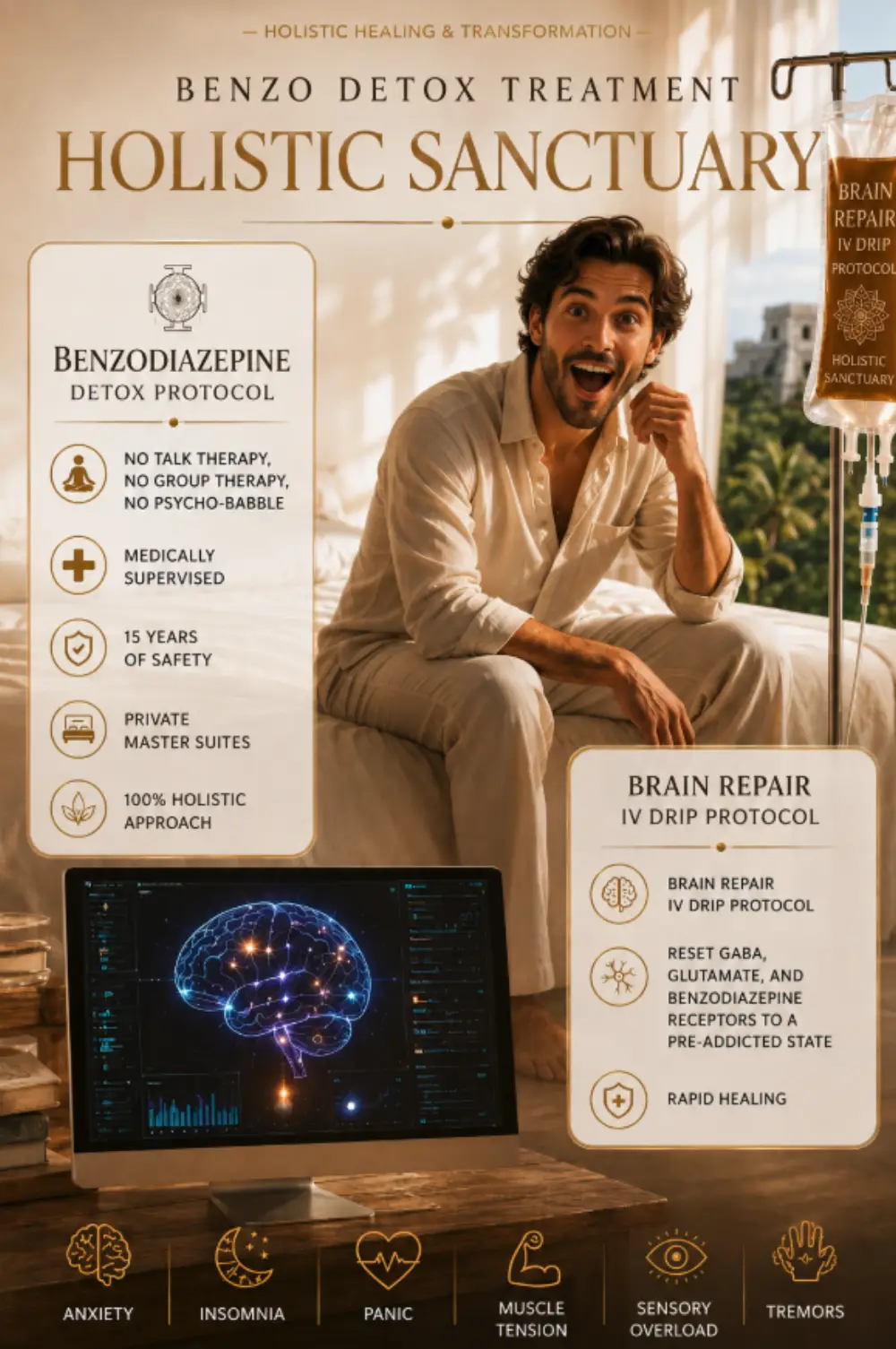
Benzodiazepine detox infographic listing symptoms addressed including anxiety, insomnia, panic, muscle tension, sensory overload and tremors alongside the medically supervised protocol
Symptoms commonly reported during benzodiazepine withdrawal. Withdrawal can be medically serious and must never be managed by stopping abruptly.

Why it is hard

What the body is actually doing.

Benzodiazepines amplify GABA, the brain’s main inhibitory signal. Under months or years of that amplification the nervous system adapts — inhibitory sensitivity down-regulates and excitatory signalling adjusts upward — so that the system runs in balance only while the drug is present.

Reduce the dose and that adaptation is briefly unopposed. What follows is not the original anxiety returning; it is a nervous system with worn brakes. People describe sensory overload, burning skin, tinnitus, tremor, muscle tension that no massage seems to reach, panic that arrives with no thought attached, derealisation, and a specific kind of insomnia that has nothing to do with being tired.

Symptoms typically come in waves and windows: days of relative clarity followed by a return of intensity that can feel like starting over. It is not starting over. It is a documented pattern, and knowing that in advance changes how people experience it.

This is why detox and withdrawal treatment have to happen in the same building. A taper schedule with no support is endurance. Support with no competent medical taper is decoration. Both belong in one plan, run by one team.

Commonly reported in benzo withdrawal

  • Rebound anxiety and panic without a trigger
  • Insomnia and fragmented sleep
  • Tremor, twitching, muscle tension, burning sensations
  • Light, sound and touch sensitivity
  • Derealisation and depersonalisation
  • Nausea, appetite loss, gastrointestinal disturbance
  • Cognitive fog and short-term memory difficulty
  • Waves and windows over weeks and months

Patterns differ from person to person. None of them indicate a character flaw. They are physiology, and they are treated as such.

The sequence

How a benzo detox runs here.

  1. 01

    Pre-arrival medical review

    Exact compound, dose, duration of use, half-life, previous taper attempts, cardiac and seizure history, and every other prescription and supplement. Nothing is scheduled until the physician has the full picture.

  2. 02

    Stabilisation

    The first days are about sleep, hydration, nutrition and nervous-system settling. Doses are usually held steady while the body adjusts to a new environment, not reduced on day one.

  3. 03

    The taper itself

    Gradual, physician-directed reductions, paced to symptom burden rather than to a calendar. Reductions pause when the person needs them to pause. No one here is taken off a benzodiazepine cold turkey.

  4. 04

    Daily withdrawal support

    Nine hours a day of one-to-one therapy and therapeutic care: bodywork, hyperbaric oxygen, sauna, red light, salt baths, cardio, reiki, yoga, nutrition, and the Brain Repair IV where cleared.

  5. 05

    Round-the-clock monitoring

    Vital signs, sleep, hydration, electrolytes, symptom scoring and medication reviewed continuously by physicians and nurses on site, twenty-four hours a day.

  6. 06

    Continuation plan

    Most people are still tapering when they fly home. Before discharge we write the next chapter with you: prescribing clinician, reduction schedule, sleep, nutrition, movement, therapy and the people around you.

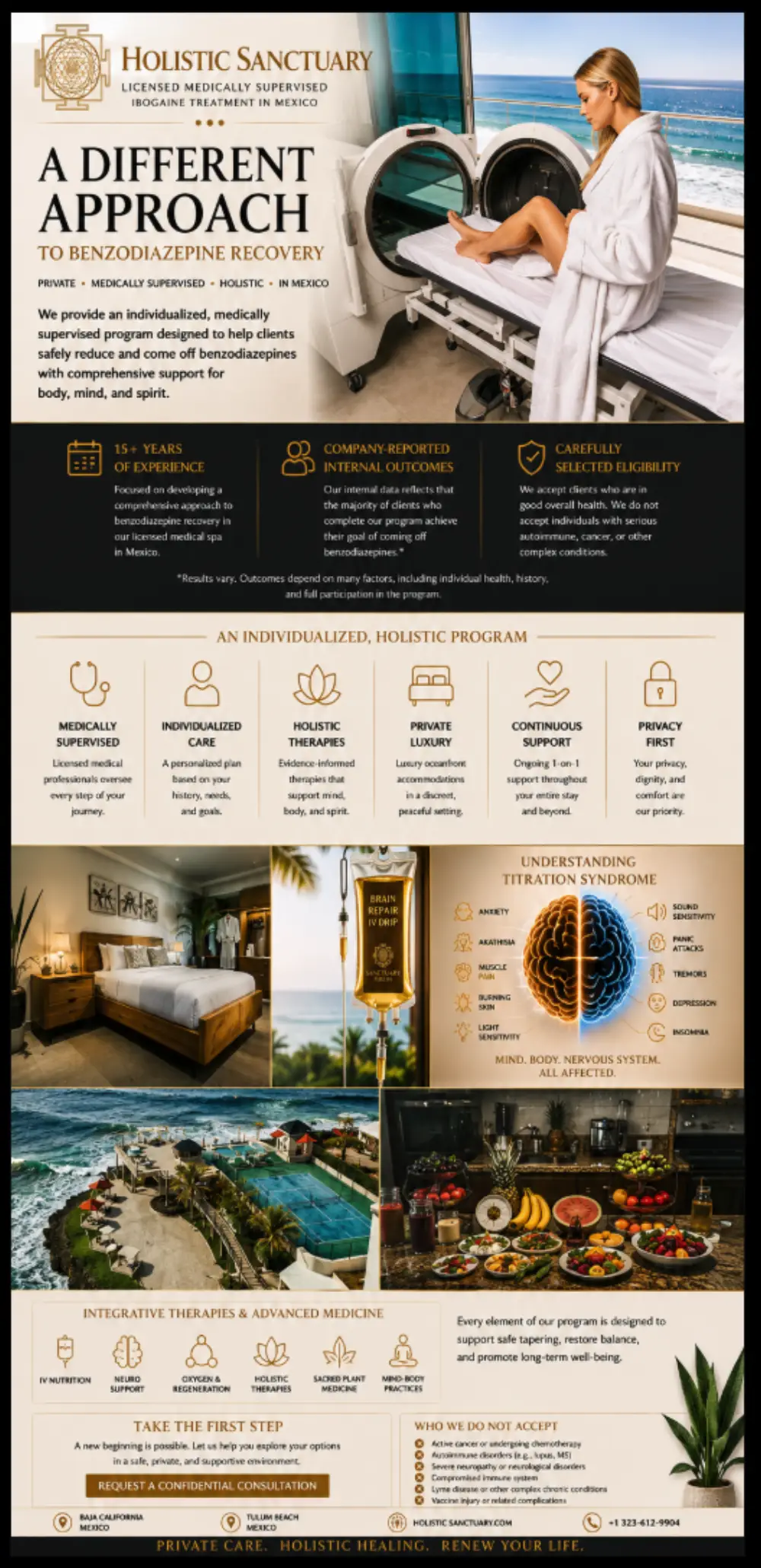
Holistic Sanctuary infographic: a different approach to benzodiazepine recovery, private, medically supervised and holistic in Mexico, with eligibility criteria and conditions not accepted
Benzodiazepine programmes are individualised and medically supervised; eligibility is assessed case by case and never involves abrupt discontinuation.

Daily support

Nine hours a day, built around the taper.

A dose reduction takes thirty seconds. Everything else in the day is what makes that thirty seconds survivable. Detox for benzo withdrawal, here, means a schedule that starts with an hour of cardio and ends with yoga, breathwork and an early night, and fills the hours between with one-to-one clinical work and physical restoration.

Movement and heat early in the day help re-anchor circadian rhythm, which withdrawal disrupts before it disrupts anything else. Bodywork and Dead Sea mineral salt baths address the muscular holding pattern that most people arrive with. Hyperbaric oxygen, infrared sauna, red light and the light system are scheduled in the afternoon, when symptom load tends to rise. Coffee enemas and organic whole-food nutrition support the detoxification and digestive side of the picture, which is rarely quiet during a taper.

And running through the middle of the day is the part no schedule can substitute for: actual therapy, one to one, with the same clinicians every day. Not a group circle. Not a workbook. Nine hours of individual attention, adjusted daily to how the reduction is going.

In the daily schedule

  • Nine hours of one-to-one therapy and therapeutic care daily
  • Brain Repair IV protocol (in-house, physician-supervised)
  • Hyperbaric oxygen therapy
  • Infrared sauna
  • Red light therapy and the light system
  • One hour of daily cardio and guided movement
  • Massage and bodywork
  • Reiki and energy work
  • Yoga and breathwork
  • Dead Sea mineral salt baths
  • Coffee enemas as part of the detoxification routine
  • Organic whole-food nutrition and cold-pressed juice

What is scheduled, and when, depends on medical clearance and on the taper. Nothing is applied uniformly.

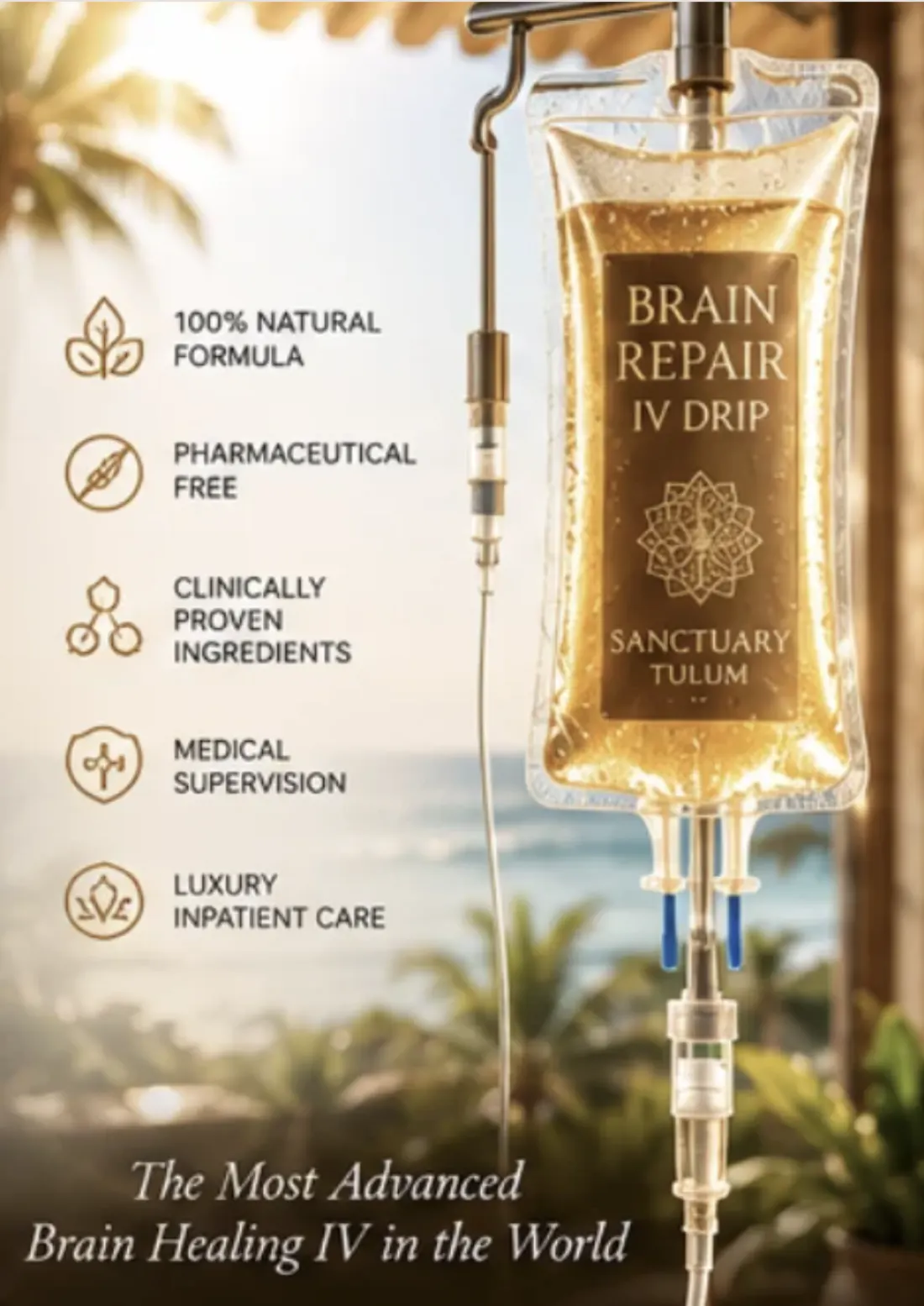
Infographic for the Brain Repair IV Drip protocol created by Johnny Tabaie: natural formula, medical supervision and luxury inpatient care
The Brain Repair IV Drip is a proprietary in-house protocol; it has not been evaluated in peer-reviewed clinical trials.

The protocol

Brain Repair, described precisely.

Holistic Sanctuary has been refining its benzodiazepine work for more than twelve years, and the element at the centre of it is an intravenous protocol we developed in-house and call Brain Repair. It is proprietary. You will not find it at another facility, because it was created here.

Precision matters, because the internet is full of approximations. Brain Repair is not NAD+. It is not red light therapy. It is not hyperbaric oxygen. It is not those three combined. It is a distinct formulation built from amino acids, peptides and neurotransmitter precursors, delivered intravenously by nursing staff on a schedule set by the physician.

The design rationale is to support the neurochemical systems that benzodiazepine dependence disturbs — GABAergic, dopaminergic, serotonergic and glutamatergic signalling — while the taper proceeds and the rest of the programme does its work. That is the intention behind the formulation, and we present it as exactly that. It has not been through peer-reviewed clinical trials, so we do not publish outcome figures or describe it as proven medicine.

We would like it studied by people with no stake in the answer. Until that happens, the responsible way to talk about it is the way a careful clinician would: here is what it contains, here is who administers it, here is what remains unknown. People in withdrawal have been promised things before. We would rather be the ones who did not.

What we can say plainly

  • It is administered under physician supervision, by nurses, on site
  • It is scheduled only after medical review and clearance
  • It runs alongside the taper, never instead of it
  • It is one part of a nine-hour day, not a stand-alone treatment
  • It is proprietary and has not been validated in clinical trials

The therapies around it — hyperbaric oxygen, sauna, red light, bodywork, nutrition, movement, sleep — are the same ones used across wellness medicine, and they are scheduled here with the same care.

The setting

Three to five residents. Private suites. Physicians on site.

A great deal of what is marketed as detox is group programming delivered at volume: shared rooms, shared curriculum, a schedule built around staffing ratios. For someone in benzodiazepine withdrawal — sound-sensitive, sleep-starved, often unable to tolerate a crowded room — that model can make things worse.

Holistic Sanctuary is roughly ten thousand square feet for three to five people. Everyone has a private master suite. Therapy is one to one. Meals are prepared individually. Physicians and nurses are here twenty-four hours a day, in the building, not on call from elsewhere.

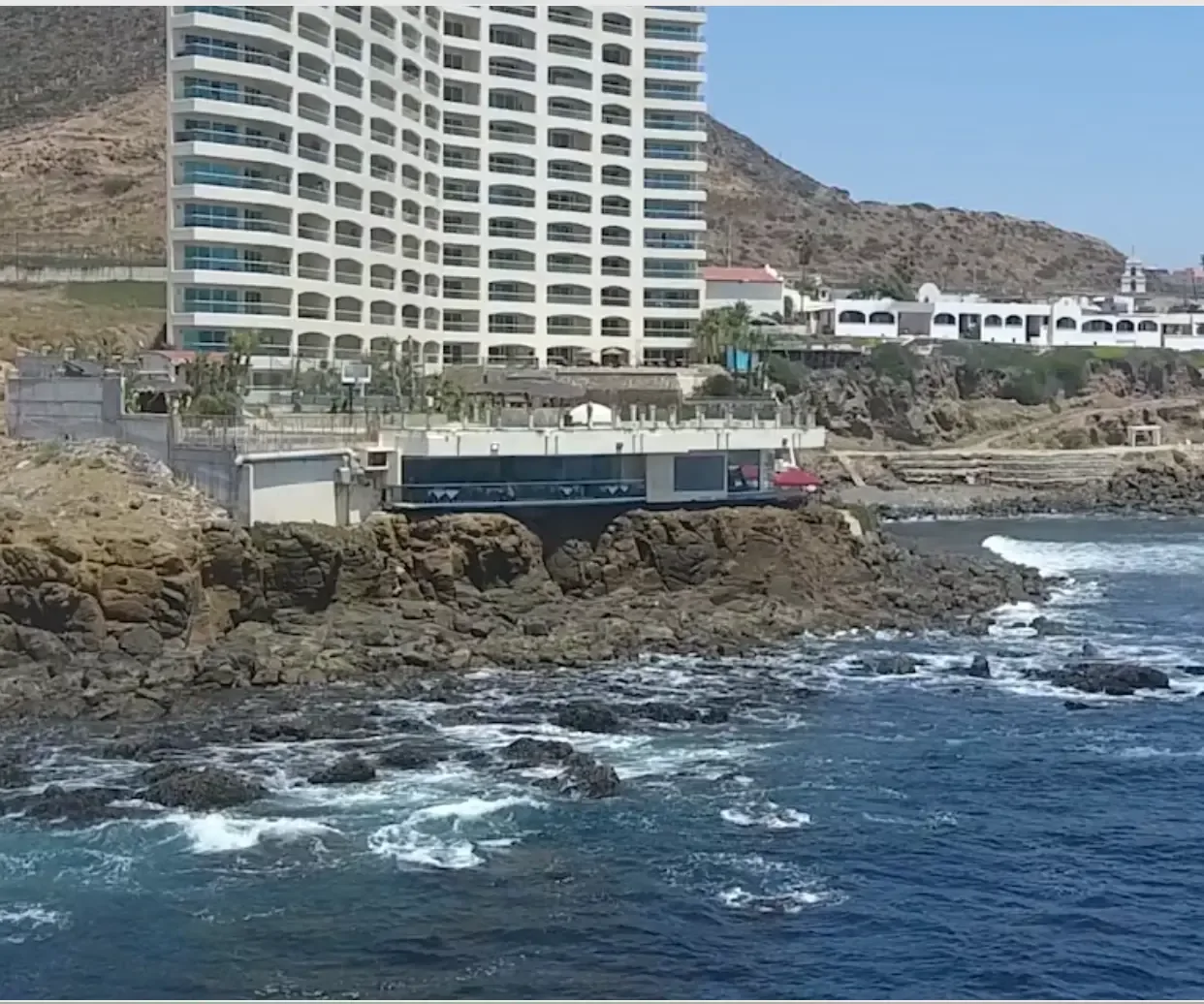
The oceanfront setting is genuinely beautiful, and it is also clinical infrastructure. Quiet matters when every sound is amplified. Privacy matters when a difficult session should not have an audience. Space matters when the day has to bend around symptoms instead of the other way round.

What the setting provides

  • Private oceanfront master suites, no shared rooms
  • Three to five residents at a time
  • Twenty-four hour physician and nursing presence
  • One-to-one therapy rather than group curriculum
  • Organic whole-food nutrition prepared on site
  • Low-stimulus surroundings for light- and sound-sensitive residents
  • Complete discretion about who is in residence
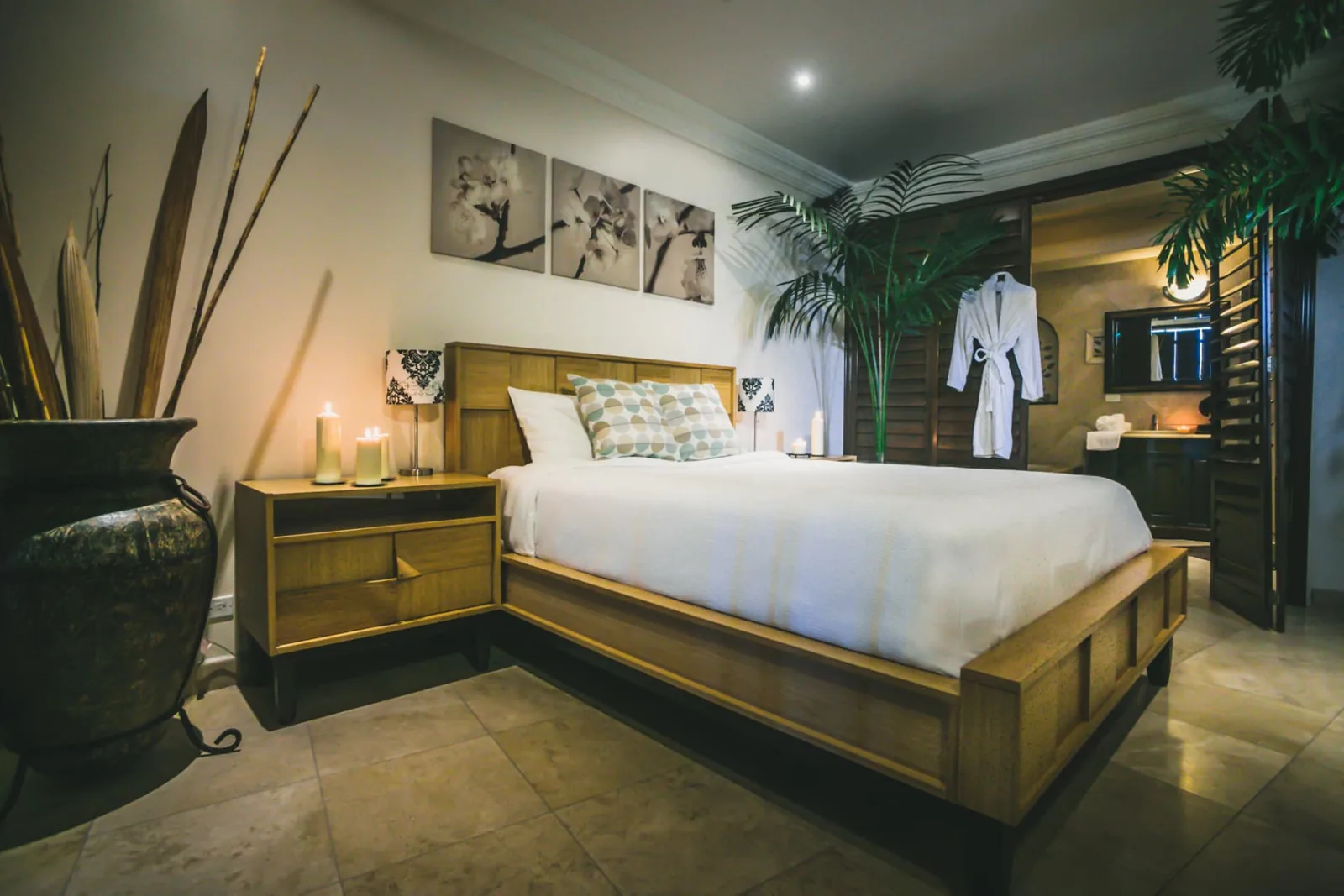
Candlelit private master suite at Holistic Sanctuary with a made bed, robe and plants
Private master suites: one resident per room, with a settled nightly routine.

Detox and after

Where detox ends and treatment continues.

Benzodiazepine detox is the medical work: reducing the dose safely, managing symptoms, monitoring the body while it re-regulates. Benzodiazepine treatment is the longer human work: sleep, nutrition, trauma, relationships, work, and rebuilding a life that no longer runs on a dosing schedule.

Almost nobody finishes both inside one residential stay, and we would rather say so than imply otherwise. Most people leave still tapering, on a schedule their prescribing clinician at home continues. That is normal, it is expected, and the aftercare plan is written with it in view.

Many residents also arrive carrying the thing that preceded the prescription — grief, trauma, PTSD, a depression that was never really treated. That work is part of the stay, not a referral for later, and it is covered in more depth on our page on holistic mental health treatment.

How admission works

  1. A confidential clinical conversation, not a sales call
  2. Full medication review — prescriptions, over the counter, supplements
  3. Laboratory work and cardiac review where a planned therapy requires it
  4. A written, individually paced plan agreed before you travel
  5. Arrival, stabilisation, then reductions when the physician says so
  6. Continuation and aftercare planned before discharge

Some people who contact us are better served elsewhere — acute psychiatric care, hospital-level medical care — and we say so on the first call.

Why we do it this way

Built by someone who went through the system.

Johnny Tabaie was prescribed Ritalin at thirteen and Adderall at fifteen. He lost his mother to addiction and his brother to suicide inside a licensed treatment facility. He was a patient in this system long before he built an alternative to it, and that is the reason this place is small, the therapy is one to one, and he is personally involved in every admission. His story is here, and the framework the programme follows is set out in the Pouyan Method.

It is also the reason we are careful with language. It would be easy to put numbers on this page. It would also be irresponsible: internal figures from a private facility are not evidence, and people in withdrawal deserve better than marketing.

We are not against medicine. Physicians run the medical side of this facility and nothing happens without them. We are not asking anyone to abandon a prescribing clinician, and nothing on this page is a reason to change a dose without one.

What we are for is a fuller definition of detox: a taper done properly, a body given what it needs to rebuild, nine hours a day of real therapeutic attention, food, sunlight, movement, touch, sleep, and enough quiet to hear yourself think again. If that is what you have been looking for, this is what we do.

Questions

Benzo detox, answered plainly.

What is a benzodiazepine detox?
A benzo detox is the medically supervised process of reducing, and where clinically appropriate discontinuing, a benzodiazepine while the symptoms of withdrawal are managed and monitored. Here it means a physician-written taper, nursing observation around the clock, and a full daily programme of therapy and body work running alongside the dose reductions.
Can benzodiazepines be detoxed at home?
Unsupervised benzodiazepine detox is not safe. Abrupt or rapid discontinuation can cause seizures, delirium and other medical emergencies, which is why national guidelines and the FDA class warning both call for gradual, clinician-led reduction. If you are currently tapering at home, speak to your prescribing clinician before changing anything, and do not stop on your own.
How long does benzo detox take?
There is no universal schedule. Many people taper over six to twelve months, and after long-term use of a short-acting benzodiazepine the process can extend toward two years. Residential detox with us is an intensive chapter inside that longer arc, and the plan is written around your history, dose, half-life and symptom pattern rather than a fixed programme length.
What is detox for benzo withdrawal like day to day?
Nine hours of one-to-one therapy and therapeutic care each day: cardio, massage, reiki, yoga, hyperbaric oxygen, infrared sauna, red light and the light system, Dead Sea salt baths, coffee enemas, organic nutrition, and the Brain Repair IV protocol where the physician has cleared it. Sessions are scheduled around how the taper is going, not around a fixed curriculum.
What is the Brain Repair IV protocol?
An intravenous protocol developed in-house at Holistic Sanctuary from amino acids, peptides and neurotransmitter precursors, delivered by nursing staff under physician supervision. It is proprietary and has not been evaluated in peer-reviewed clinical trials, so we describe what it is and how it is given rather than what it will do for you. It is not NAD+, red light or hyperbaric therapy, and it is not those combined.
Do you switch people to a long-acting benzodiazepine first?
Sometimes. Whether a substitution to a longer half-life benzodiazepine is appropriate is a clinical decision made by the physician after reviewing your medication history, and it is one of several approaches described in the tapering literature. It is never a default.
How many residents are here at one time?
Three to five, in roughly ten thousand square feet. Private master suites, no shared rooms, no group curriculum, and physicians and nurses on site twenty-four hours a day.
Is benzo detox covered by insurance?
No. Care here is private and paid out of pocket. The programme runs in Mexico, where this intensity of one-to-one medical and holistic care can be delivered for a fraction of what an equivalent private arrangement costs in the United States.

References

Sources for the clinical statements above.

  1. 01U.S. Food and Drug Administration — Boxed warning updates for benzodiazepines covering abuse, dependence, withdrawal and misuse (2020). Source
  2. 02National Institute for Health and Care Excellence — Medicines associated with dependence or withdrawal symptoms: safe prescribing and withdrawal management (NG215). Source
  3. 03American Society of Addiction Medicine — Clinical considerations for benzodiazepine tapering (2023 joint clinical practice guideline). Source
  4. 04Ashton CH — Benzodiazepines: how they work and how to withdraw (the Ashton Manual). Source
  5. 05Soyka M — Treatment of benzodiazepine dependence. New England Journal of Medicine. Source

Related

Benzodiazepine Treatment

Holistic Benzodiazepine Treatment

Physician-supervised benzodiazepine detox and withdrawal support: gradual tapering, nine hours of daily one-to-one therapy, the in-house Brain Repair IV protocol, and whole-body restoration in a private oceanfront setting.

Holistic Treatment

Holistic Rehab

Rehabilitation as system repair: mental health, behavior, environment, nutrition and sleep, with specialized medical support where it is needed.

Mental Health

Holistic Mental Health Treatment

An integrative approach to PTSD, trauma, depression and anxiety that treats sleep, nutrition, environment and behavior as clinical variables.

Holistic Treatment

Holistic Treatment Center

What an integrative treatment center actually does: clinical oversight, nutrition, environment and individualized programming under one roof.

Insights

Latest Insights

Browse all insights

Ibogaine

Best Ibogaine Treatment Centers

A consumer guide to evaluating an ibogaine provider: screening, cardiac assessment, medical oversight, emergency preparedness and transparency.

Benzodiazepine Treatment

Holistic Benzodiazepine Treatment

Physician-supervised benzodiazepine detox and withdrawal support: gradual tapering, nine hours of daily one-to-one therapy, the in-house Brain Repair IV protocol, and whole-body restoration in a private oceanfront setting.

Mental Health

Holistic Mental Health Treatment

An integrative approach to PTSD, trauma, depression and anxiety that treats sleep, nutrition, environment and behavior as clinical variables.

Holistic Treatment

Holistic Rehab

Rehabilitation as system repair: mental health, behavior, environment, nutrition and sleep, with specialized medical support where it is needed.

Ibogaine

Ibogaine Integration

Why the weeks after an experience matter: reflection, behavior, sleep, nutrition, relationships, meaning and ongoing professional support.

Ibogaine

Ibogaine Preparation

Medical, psychological and practical preparation: history, medication review, ECG, laboratory assessment, consent and integration planning.

Ibogaine

Ibogaine Safety

QT prolongation, arrhythmia risk, CYP2D6 metabolism, drug interactions and electrolytes — what the safety literature establishes and what remains uncertain.

Ibogaine

Ibogaine Treatment

A comprehensive, evidence-led resource on ibogaine: pharmacology, the research base, cardiac risk, candidacy, preparation and integration.

Ask about a supervised taper.

A confidential conversation about your compound, your dose and what a physician-directed benzodiazepine detox would look like for you. No script, no pressure.